What Is HRV in Dogs? Reading Stress Through the Parasympathetic Nervous System
It's hard to be sure your dog is stressed from behavior alone. One number owners can use as an objective clue is a dog's HRV (heart rate variability). HRV is often cited as an indicator that hints at parasympathetic activity, and steadily recording its everyday changes can help you notice shifts in your dog's condition sooner.

What exactly is HRV in dogs?
HRV (Heart Rate Variability) is a measure of how much the time interval between successive heartbeats (the RR interval) varies. Where heart rate is a per-minute average, HRV focuses on the tiny rhythm changes between individual beats. In human clinical practice it has been standardized as a measure of autonomic function since the 1996 ESC/NASPE Task Force guidelines, and dog-focused research has steadily appeared more recently in journals such as Frontiers in Veterinary Science.
Defining HRV and the autonomic nervous system
The autonomic nervous system, which works independently of our will, has two branches: the sympathetic nervous system (arousal and alertness) and the parasympathetic nervous system (calm and recovery). The more relaxed and at rest a dog is, the more the parasympathetic branch tends to dominate, producing natural variability in the intervals between beats — and HRV tends to measure relatively higher.
The relationship between HRV and the parasympathetic nervous system
It's easy to declare that "higher HRV is always better," but the general consensus is that the amount of change relative to the individual's baseline is more meaningful. Beyond human studies, some observational studies in dogs have also reported that HRV tends to drop temporarily upon exposure to a new environment or a separation stimulus.
What low HRV means
Low HRV is hard to interpret from a single cause. Temporary stimuli, the period right after eating or exercise, excitement, changes in breathing pattern, pain, and chronic stress can all play a part. Rather than drawing a conclusion from a one-off dip, you should look at the trend over days to weeks.
Why RMSSD is used so often
There are several ways to compute HRV, and among them RMSSD (Root Mean Square of Successive Differences) is the root mean square of the differences between adjacent RR intervals. It is stable even in short measurements and is known to sensitively reflect changes in parasympathetic (vagal) activity, which is why it is cited most often (ESC/NASPE 1996; numerous PubMed entries). Unlike metrics such as SDNN that need longer recordings, it is well suited for owners to track day to day even from a short resting measurement.
A dog's HRV "normal range" and influencing factors
The "normal range" of absolute values is wide and varies with age, breed, build, and measurement conditions. For example, the commonly referenced resting heart rate range is about 80-120 bpm for small dogs and about 60-100 bpm for medium and large dogs (MSD Veterinary Manual, Cardiovascular System), and HRV shows even greater individual variation. For that reason, a globally applicable cutoff such as "below this number is dangerous" is not recommended. It is far more meaningful to know your own dog's usual baseline and see how far it has strayed from it.
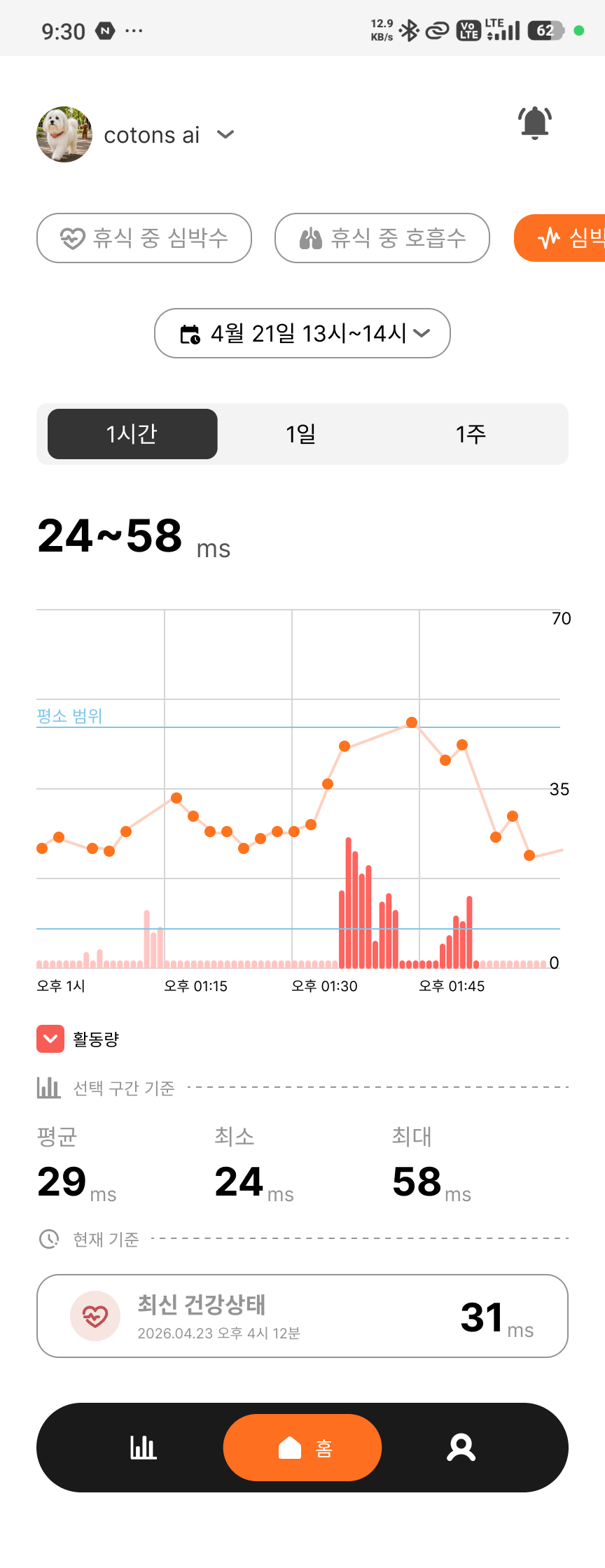
How to measure and record a dog's HRV at home
Because HRV wobbles temporarily right after exercise, after eating, or right after an unfamiliar stimulus, the key is to measure at a consistent time of day in a resting state. Owners can't time beat intervals with a stethoscope themselves, so a dedicated measurement setup for dogs is needed.
How to track it with sense 1 home
cotons ai's sense 1 home uses a BCG sensor to measure resting heartbeats without contact, and at the same time records activity with a 6-axis IMU sensor. HRV is derived from these measurements using the RMSSD method, helping owners check the trend of parasympathetic activity day by day. Rather than a single absolute value, it's recommended to look at how the same-time-of-day baseline moves over days to weeks in the app. Note that this record is a reference that helps owners notice changes sooner, and does not replace the diagnosis or treatment of disease.

Frequently asked questions
My dog's HRV suddenly dropped. Do I need to go to the vet right away?
A one-off dip is common after eating, right after a walk, or with an unfamiliar stimulus. If you see a sustained decline relative to baseline over days to weeks along with other signs such as changes in behavior, appetite, or breathing, it's safer to consult a vet.
Are the HRV benchmarks the same for puppies and senior dogs?
No. Generally, the younger and smaller the dog, the higher the average heart rate, and HRV patterns differ too. So change relative to the individual's own baseline is a more meaningful basis for judgment than absolute values.
Can HRV change even without stress?
Yes. Breathing pattern, posture, excitement, the period right after a meal, and changes in body temperature all have an effect. That's why repeating measurements in a resting state under conditions as similar as possible improves reliability.
Key takeaways
- A dog's HRV reflects the variability of beat intervals and is used as an indicator that hints at parasympathetic activity.
- The RMSSD method reflects parasympathetic changes relatively sensitively even in short measurements (ESC/NASPE 1996).
- The amount of change relative to the individual's baseline is more meaningful than the normal range of absolute values.
- Avoid the period right after exercise, eating, or excitement, and repeat measurements in a resting state at the same time of day.
- sense 1 home records resting heart rate, HRV (RMSSD), and activity together with BCG + 6-axis IMU sensors, providing a reference you can use to track everyday changes (not for diagnosis or treatment).
Closing
A dog's HRV is not "a single number that shows stress," but an objective clue that helps owners notice changes in everyday condition sooner. Without steady records, it's hard to read meaning from just one or two values. If you want to record your dog's HRV changes day to day, check resting heart rate and HRV daily with sense 1 home. That said, if the changes are large or accompanied by behavioral abnormalities, be sure to consult a vet.
Sources / References
- Task Force of the European Society of Cardiology and the North American Society of Pacing and Electrophysiology. Heart rate variability: Standards of measurement, physiological interpretation, and clinical use. Circulation, 1996.
- MSD Veterinary Manual. Cardiovascular System — Heart Rate and Rhythm in Dogs. msdvetmanual.com.
- Frontiers in Veterinary Science. Reviews and observational studies related to Heart Rate Variability in Dogs. frontiersin.org.
- Shaffer F., Ginsberg J.P. An Overview of Heart Rate Variability Metrics and Norms. Frontiers in Public Health, 2017.
This content is for general health-information purposes only and does not replace veterinary care. Any judgment about an individual pet's condition must be made through veterinary examination.