Brachycephalic Dog Breathing Rate: Where Breed Traits End
Your French Bulldog snores through the night. Your Pug is still puffing long after the walk is over. Your Shih Tzu hacks a little after every drink of water. Owners hear "that's just how flat-faced dogs are" constantly, but that sentence gives you nothing to act on. This article covers the baseline for a brachycephalic dog breathing rate, the anatomy behind the effort, the warning signs you can check at home, and the situations that mean you call the clinic now.
Key takeaways
- A healthy adult dog at rest breathes roughly 15 to 30 times per minute, with sources citing ranges as wide as 16 to 32 (Merck Veterinary Manual, normal vital sign ranges).
- Veterinary cardiology treats a sleeping or settled respiratory rate that stays above 30 breaths per minute as a value worth investigating (ACVIM MMVD consensus guidelines, JVIM 2019).
- While panting, a dog's respiratory rate can climb past 200 breaths per minute, so you must wait for the panting to stop before you count (Merck Veterinary Manual, heat stress).
- Flat-faced breathing effort comes from narrowed nostrils, an elongated soft palate and a narrow windpipe stacking up into high upper airway resistance. This condition is called brachycephalic obstructive airway syndrome, or BOAS.
- For a flat-faced dog, the useful benchmark is not an absolute number but the change from that individual dog's own usual value. If you do not know the usual number, you cannot spot the day it shifts.
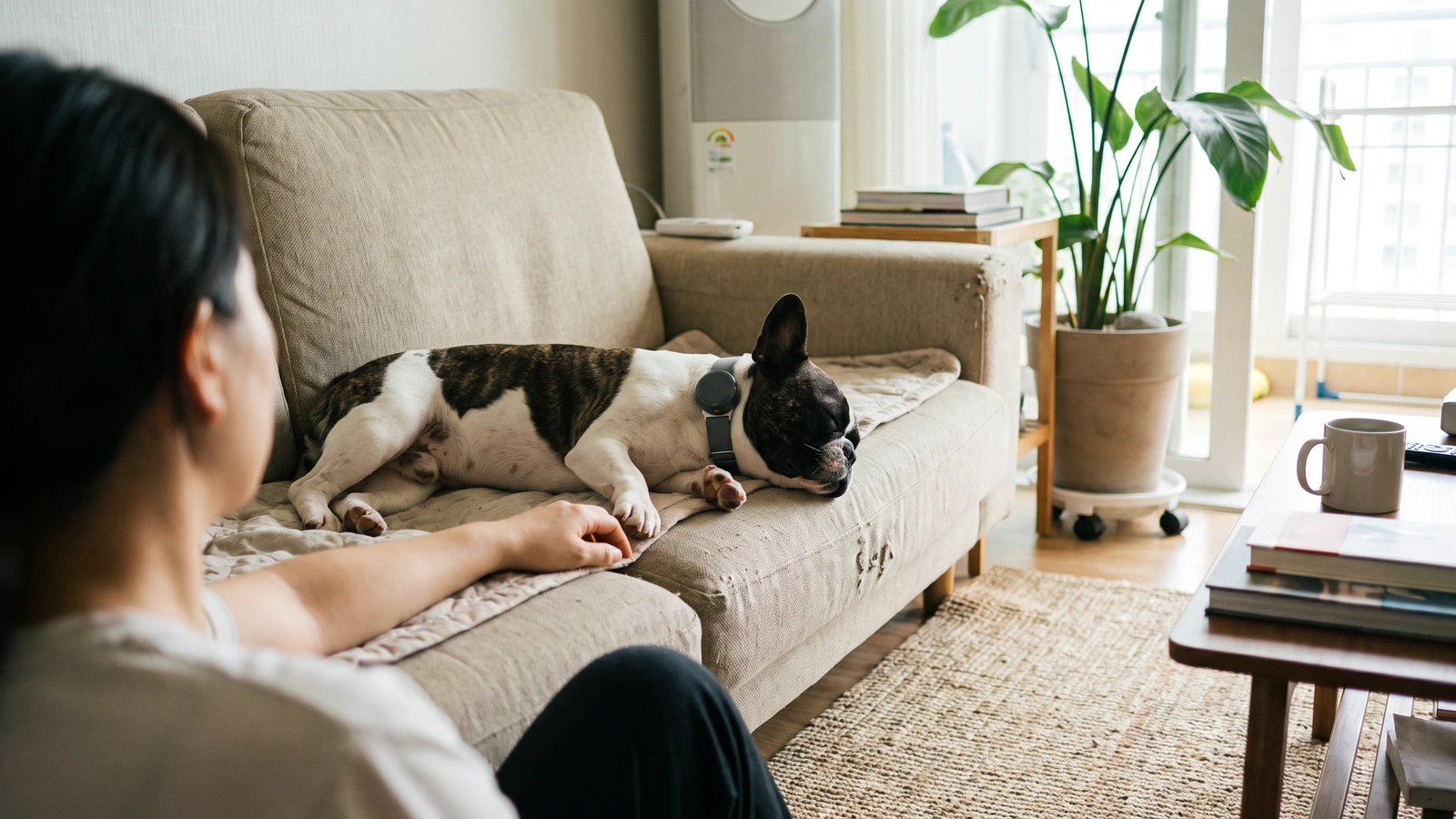
What is a normal brachycephalic dog breathing rate?
A healthy adult dog at rest breathes about 15 to 30 times per minute, with some sources giving a slightly wider 16 to 32 range (Merck Veterinary Manual, normal vital sign ranges). That figure applies across breeds. There is no separate official standard that grants flat-faced dogs a wider "normal" band. What is true is that their airway resistance is structurally higher, so after the same activity their rate often stays elevated for longer.
Resting rate and panting rate are two different numbers
Resting respiratory rate and panting rate cannot be read as the same measurement. Panting is shallow, rapid breathing a dog uses to shed heat, and the rate during panting can exceed 200 breaths per minute. A number counted mid-pant tells you almost nothing about health. To count properly, your dog needs to be asleep or lying quietly, mouth closed, breathing through the nose.
Why your dog's own baseline beats the absolute number
For flat-faced dogs, the change from that individual's usual value is more informative than an absolute cutoff such as the 30 breaths per minute figure used in heart disease management. One French Bulldog might sleep at 18 breaths per minute and another at 26. If a dog that normally sits at 18 has been running at 27 for several days, 27 is still inside the normal band, but for that dog it is a 50 percent increase. The ACVIM consensus that pairs the absolute 30 breaths per minute threshold with a rise above the patient's own baseline was built on the same logic (Keene et al., JVIM 2019). That threshold, however, was created for managing myxomatous mitral valve disease, so it cannot be lifted wholesale into judging an upper airway problem in a flat-faced dog.
The anatomy behind the effort
What is brachycephalic obstructive airway syndrome (BOAS)?
Brachycephalic obstructive airway syndrome (BOAS) is a condition in which breeds with a shortened skull develop high resistance to airflow through the upper airway because narrowed nostrils (stenotic nares), an elongated soft palate and overgrown nasal turbinates stack on top of each other (Royal Veterinary College). The bone got shorter, but the soft tissue inside it (soft palate, turbinates, tongue) did not shrink to match, so the same volume of tissue is packed into a smaller space.
It matters most in French Bulldogs, Pugs, English Bulldogs, Boston Terriers, Shih Tzus and Pekingese. In a large analysis of UK primary care records, Royal Veterinary College VetCompass researchers reported French Bulldogs as a breed with a notably high rate of diagnoses related to upper airway obstruction compared with the wider dog population (O'Neill et al., Canine Medicine and Genetics, 2021).
Primary and secondary lesions feed each other
BOAS tends to worsen over time because the pressure created by the structures a dog was born with (primary lesions) generates new changes (secondary lesions).
| Type | Findings |
|---|---|
| Primary (present from birth) | Stenotic nares, elongated soft palate, turbinate overgrowth, hypoplastic trachea |
| Secondary (develops over time) | Everted laryngeal saccules, tonsillar enlargement, laryngeal collapse |
Pulling air through a narrow passage on inhalation requires greater negative pressure inside the chest and airway. That pressure repeatedly draws the soft mucosa below the obstruction inward, and combined with swelling and inflammation, tissue that started out normal becomes floppy and thickened. The passage narrows further, which demands even more negative pressure. Much of what owners describe as "the noise got louder this year" is this process.
What louder breathing actually means
Louder breathing means air is generating more turbulence as it passes through a narrowed passage. Quiet breathing happens when air flows smoothly, and the faster air moves through a tight space, the more noise it makes. That makes the comparison against last month or last year far more useful than the absolute loudness on any given night.
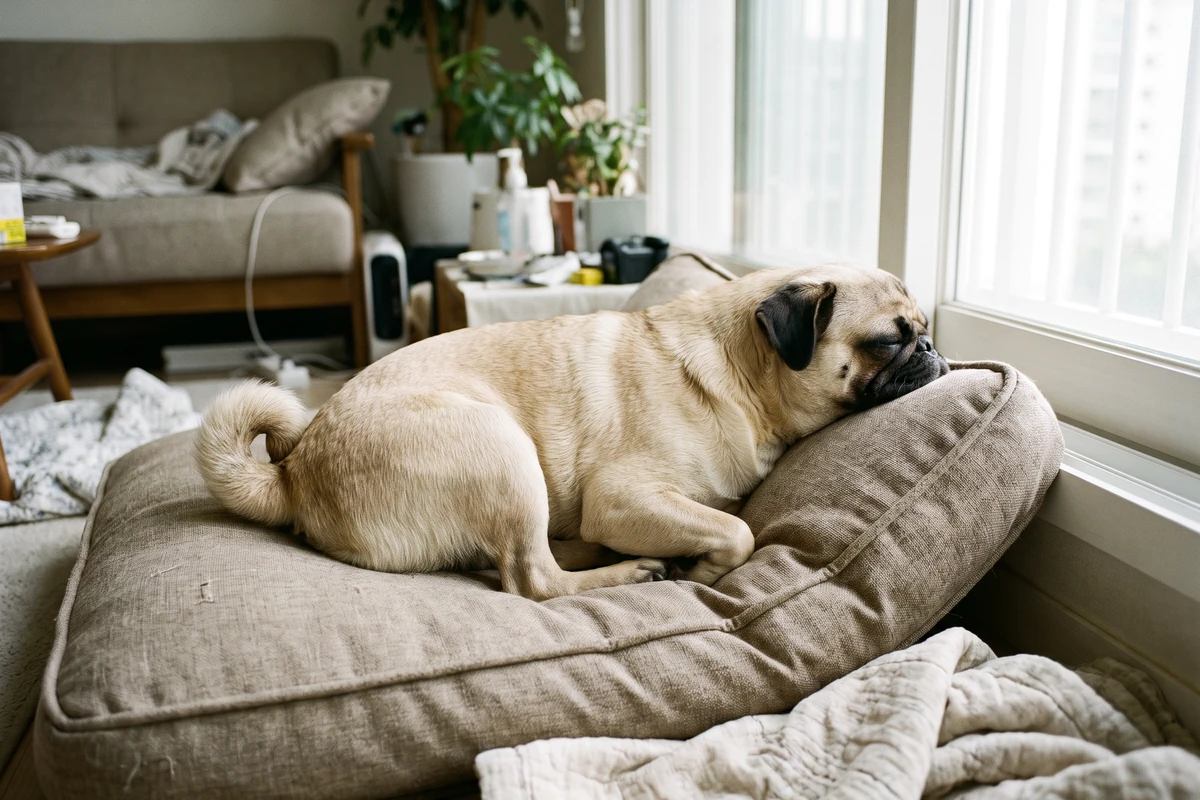
Signs of breathing effort you can check at home
Breathing effort is easiest to track along four axes: sound, posture, recovery time and mucous membrane colour.
Sound: snoring, stertor and reverse sneezing
The three noises come from different places, so it helps to keep them separate.
- Snoring: a low, continuous sound produced when the soft palate vibrates during sleep. Common in flat-faced dogs, but treat it as a change when it gets louder or starts showing up while the dog is awake.
- Stertor and stridor: stertor is a snoring-type sound from the nose and pharynx; stridor is a high, harsh sound that appears when the larynx narrows. A stridor that was not there before is worth particular attention.
- Reverse sneezing: a paroxysmal episode of pulling air in sharply through the nose with a honking sound, usually brief. It is not an emergency on its own, but note it if the frequency climbs clearly and mention it at your next visit.
Posture: a stretched neck or sleeping propped up
A change in sleeping posture can be an attempt to hold the airway open. If your dog starts stretching its neck out long, resting its chin on a toy or the edge of a step, or insisting on lying sternally instead of on its side, it may be positioning itself to breathe. Waking frequently and constantly resettling belong in the same picture.
Recovery time after a walk
Recovery time is the most reliable thing you can track, as long as you compare the same route. If your dog used to settle within five minutes after a given distance in given weather and now takes fifteen, that change is the information. Adjust the intensity and jot down how long recovery took, even a couple of lines.
Gum colour, tongue colour and fainting
Pale or bluish gums or tongue, and any episode of fainting, mean you go to the clinic without waiting. A colour change in the mucous membranes can appear when oxygen delivery is insufficient, and it is not something to monitor at home. Look at your dog's gums while they are healthy so you know which shade of pink is normal for them.
Why summer is harder on flat-faced dogs
Dogs cannot cool themselves by sweating over the body the way people do, and they depend heavily on evaporative cooling through panting (Merck Veterinary Manual, heat stress). Panting is a dog's main cooling mechanism. For flat-faced dogs, that channel is exactly the narrow one. Cooling down requires more panting, more panting swells the tissue inside an already tight airway, and swelling narrows the passage further, which drops cooling efficiency.
Midday summer walks, waiting in a parked car and excited indoor play are all situations where that loop can run its course quickly. On hot days, shift walks to early morning or late evening, check pavement temperature with the back of your hand, and build pauses into indoor play so excitement does not run long.
How to count resting breaths at home
The counting procedure
Count a resting respiratory rate in this order.
- Wait until your dog is asleep or lying quietly with its mouth closed. Do not count while it is panting.
- Count one rise and fall of the chest or flank as one breath, for 60 seconds. That count is the breaths-per-minute figure.
- Only if a full 60 seconds is impractical, count for 30 seconds and multiply by two. Counting 15 seconds and multiplying by four carries too much error to recommend.
Where you can, measure at the same time of day in the same situation and log it with the date. A week of numbers tells you far more than a single reading.
Logging resting respiratory rate with Sense 1 Home
The limitation of counting by hand is that it is hard to do every day. It means sitting beside a sleeping dog for a full minute, you miss days, and the overnight hours while you are asleep stay blank.
Sense 1 Home from cotons ai records resting respiratory rate, resting heart rate, HRV (RMSSD) and activity while your dog rests or sleeps. Measurement uses BCG (ballistocardiography) to read fine body vibrations, paired with a 6-axis IMU sensor that tracks movement and posture. HRV is calculated as RMSSD and is used as an indicator of parasympathetic activity.
For an owner of a flat-faced dog, the value sits in the baseline. You can see roughly where your dog's sleeping respiratory rate sits, how that value differs between summer and winter, and whether it moved during a week when you changed walk intensity. Knowing the usual range turns a vague "the noise seems louder lately" into several days of recorded numbers you can keep. Recorded values alone cannot determine your dog's health status, and if you suspect something is wrong, take your dog to a veterinarian.

When to call the vet right away
Contact your clinic immediately, rather than watching and waiting, if any of the following apply.
- Pale or bluish gums or tongue
- Collapse or loss of consciousness
- Sitting or standing with the neck extended, gasping, unable to lie down
- Panting that will not settle even after moving somewhere cool
- A settled respiratory rate that stays clearly above normal for several days running
- Coughing or retching alongside a sudden increase in breathing noise
- On a hot day: staggering or disorientation, vomiting or diarrhoea, brick-red gums, dulled responsiveness (suspected heatstroke)
Frequently asked questions
What is a normal brachycephalic dog breathing rate?
A brachycephalic dog breathing rate at rest is judged against the same figure as any other breed, about 15 to 30 breaths per minute and as wide as 16 to 32 in some sources (Merck Veterinary Manual, normal vital sign ranges). Flat-faced breeds do not get an officially wider normal band. Individual variation is large, though, so knowing your own dog's usual value and how far the current number sits from it gives you a more accurate read.
My French Bulldog snores in its sleep. Is that okay?
Snoring in a French Bulldog is common among flat-faced breeds, but common does not mean harmless. The thing to judge is change rather than presence. Ask whether the sound has grown louder, whether you now hear it while the dog is awake, and whether the dog wakes often or keeps shifting position. When those show up together, they belong on the list for your next appointment.
My Pug takes forever to catch its breath after a walk. What should I do?
If your Pug's recovery after a walk is taking longer than it used to, first compare like with like: same route, same weather. Split walks into shorter segments and use shade and water more often. If panting continues even after resting somewhere cool, or the gum colour changes, call the clinic straight away.
How do I check for breathing effort at home?
You check breathing effort in a flat-faced dog along four axes: sound, posture, recovery time and mucous membrane colour. Has the breathing noise grown louder, has the dog started sleeping with its neck stretched or lying sternally, has post-walk recovery slowed, does the gum colour look different from usual. When two or more of the four have shifted together, book an appointment.
When does summer panting in a flat-faced dog need a vet?
Summer panting in a flat-faced dog needs veterinary attention when it does not settle after you move the dog somewhere cool and let it rest. Dogs shed heat through evaporative cooling from panting (Merck Veterinary Manual, heat stress), and flat-faced breeds run that process less efficiently. If staggering, vomiting, changed gum colour or dulled responsiveness appear alongside it, treat it as an emergency and call immediately.
How do I measure a dog's resting respiratory rate?
You measure a dog's resting respiratory rate by counting the rise and fall of the chest for 60 seconds while the dog is asleep or lying quietly. If a full minute is impractical, count 30 seconds and multiply by two. Avoid counting during panting, straight after play, or right after a stranger arrives, since all of those push the number up. Measuring at the same time each day lets you see the trend.
What sleeping respiratory rate should I use as a reference?
Sleeping respiratory rate is often used as a monitoring figure because it reflects a genuinely settled state. Veterinary cardiology treats a sleeping rate that persistently exceeds 30 breaths per minute as a value that warrants investigation (ACVIM MMVD consensus, JVIM 2019). That threshold was built for managing heart disease, so it is not a direct test for an upper airway problem in a flat-faced dog. Working out why a number rose is your veterinarian's job.
Summary
- Normal resting respiratory rate is about 15 to 30 breaths per minute (16 to 32 in some sources), and flat-faced breeds have no separate wider standard.
- Never use a number counted during panting. Count while the dog is asleep or lying quietly.
- Breathing effort in flat-faced dogs traces back to BOAS, where narrowed nostrils and an elongated soft palate raise airway resistance.
- At home, watch four axes: sound, posture, recovery time and mucous membrane colour.
- Change against your own dog's usual value beats any absolute number, so logging a baseline resting respiratory rate is the starting point.
Closing
The practical question about a brachycephalic dog breathing rate is not "is this normal?" but "is this the same as usual?" Flat-faced dogs start with structurally high airway resistance, which makes a single absolute threshold a poor line between fine and not fine. Comparing your dog's usual value against today's gives you far clearer information, and a few days of records is enough to make that comparison possible.
If you do not know roughly where your dog's resting respiratory rate sits, record breathing and activity through the night with Sense 1 Home for a few days. Knowing the usual range makes the day it changes easier to notice.
This article is for general information only and does not replace veterinary care. Sense 1 Home is not a medical device and does not diagnose, treat, or prevent any disease. If you suspect a problem with your dog's breathing, take them to a veterinary clinic.
Sources
- Merck Veterinary Manual, "Normal Rectal Temperature, Pulse, and Respiration Ranges", "Respiratory Diseases of Dogs", "Heat Stress and Heatstroke in Animals". Merck & Co. https://www.merckvetmanual.com
- Keene BW, Atkins CE, Bonagura JD, et al. "ACVIM consensus guidelines for the diagnosis and treatment of myxomatous mitral valve disease in dogs." Journal of Veterinary Internal Medicine, 2019;33(3):1127-1140. https://onlinelibrary.wiley.com/doi/10.1111/jvim.15488
- Royal Veterinary College. Brachycephaly and BOAS research. https://www.rvc.ac.uk/research/research-centres-and-facilities/brachycephaly
- Dupré G, Heidenreich D. "Brachycephalic Syndrome." Veterinary Clinics of North America: Small Animal Practice, 2016;46(4):691-707. https://pubmed.ncbi.nlm.nih.gov/27012936/
- O'Neill DG, Packer RMA, Francis P, et al. "French Bulldogs differ to other dogs in the UK in propensity for many common disorders: a VetCompass study." Canine Medicine and Genetics, 2021;8:13. https://cgejournal.biomedcentral.com/articles/10.1186/s40575-021-00112-3
- American Veterinary Medical Association (AVMA). "Warm weather pet safety." https://www.avma.org/resources-tools/pet-owners/petcare/warm-weather-pet-safety